
The Little Club with the Heart of Gold
-
Cambridge Bridge Club Golden Jubilee
1976 – 2026
Bridge has been part of Cambridge social life for well over a century.
In the late nineteenth and early twentieth centuries, the game was played in private homes, often noted in local newspapers alongside descriptions of the setting and the players. These gatherings reflected a particular social world, where invitation and status mattered as much as the game itself.
By the mid-twentieth century, bridge had become more accessible. The Lyceum Club, established in 1940, hosted regular sessions with up to ten tables in play. At the same time, experienced players often travelled to Hamilton or Te Awamutu to compete, highlighting both the game’s popularity and the absence of a local club.
The establishment of a Cambridge club in 1976 marked a shift. What had once been played in homes and small groups became a structured, community-based weekly competition.
Rosemary Stephenson and Betty Taylor were the first to gauge the level of interest for a bridge club in Cambridge. They advertised a public meeting at the Cambridge Intermediate School. It was well attended by enthusiastic people who immediately established a steering committee.
In March 1976, an inaugural bridge night was held in the St Andrew’s church hall. The room was packed with 18 tables and 72 players. The committee now knew that establishing a Cambridge bridge club was feasible.
An AGM was held on 22 March and the Cambridge Contract Bridge Club was launched. Rosemary Stephenson was elected President. Bridge tables were donated and purchased. Henry Davys, managing director of local building firm Speight, Pearce Nicoll and Davys (SPND), made two sets of 28 boards to hold the playing cards, and later a trolley to hold the card tables so they could be easily stored. The Hamilton club was supportive of the new club, lending it boards and other equipment and supplies to get it started.
Originally, members played one night a week. This was soon split into two nights: Mondays for experienced players, and Wednesdays for newer players – as it is today. ACOL was the only system played and Sue Wrigley, an experienced player, was director, scorer and tutor for about five years. Club nights were held in the St John Building on Victoria Street (now Property Brokers Real Estate), but this had a concrete floor and was cold and noisy. The club moved to the Alf Walsh room at the Cambridge Trotting Club, where it stayed for about seven years.
The Clubrooms
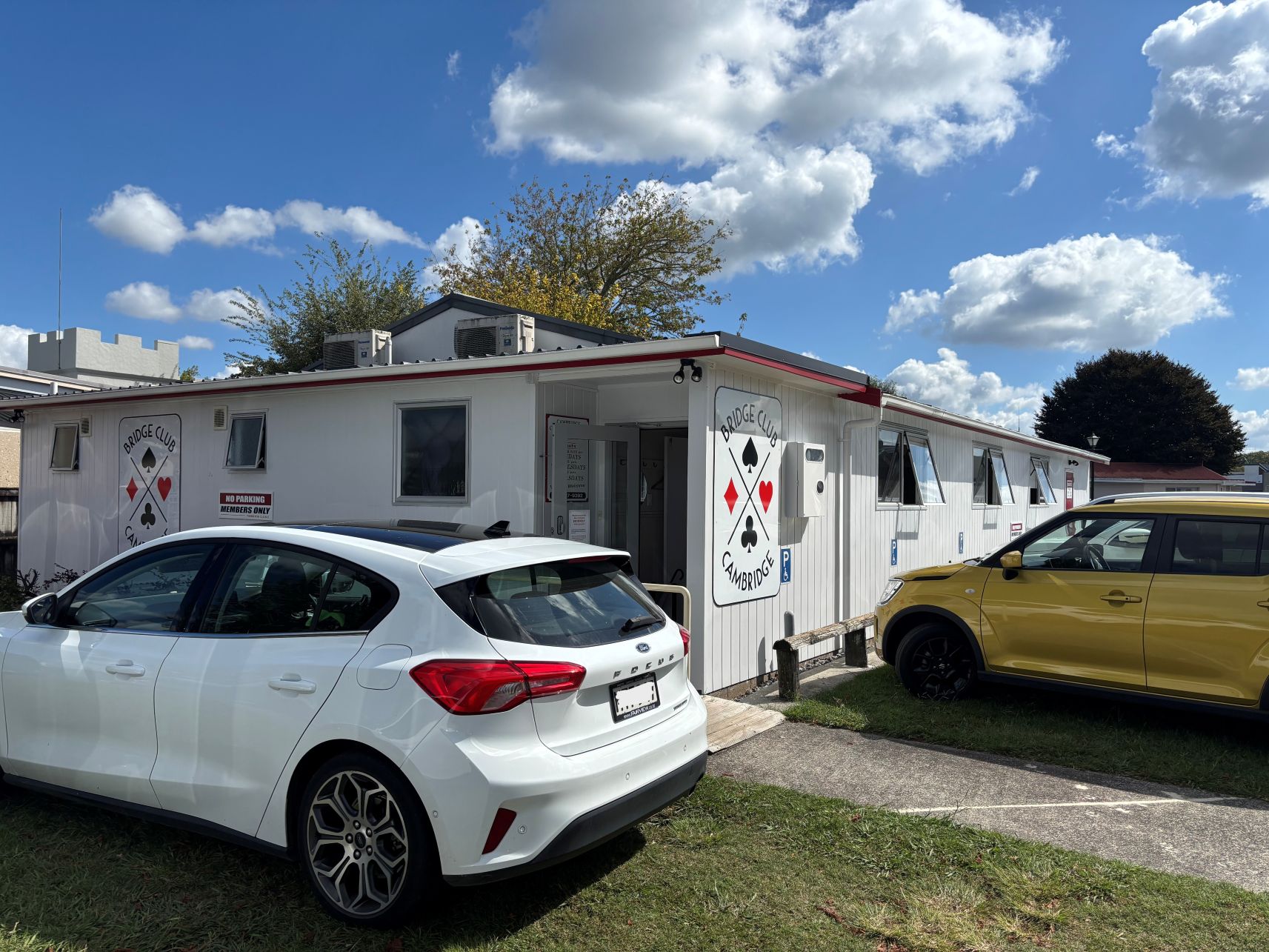
Money was constantly set aside for the purchase of the club’s own premises. One option was the old courthouse. Another was jointly owning a property with Federated Farmers.
Des Robinson was a driving force when he was Club President in 1981-1983. On 18 March 1983, the club, now an incorporated society, signed a lease with the Cambridge Borough Council for a vacant property on 14 Fort Street.
Funding initiatives
Money was raised by $13,000 cash from club funds, $7,000 from gifts, a $10,000 loan from the Bank of New Zealand and $10,000 in debentures from club members.
Local Accountant Graham Wrigley, the club’s Treasurer, was the brains behind the debenture scheme. Members put up money secured by a debenture, which was in effect a promise by the club to pay the sum back. No interest was paid. In the subsequent years, an annual draw was made for a percentage of the debentures to be paid back that year. Some donated the money instead of accepting payment. It was an innovative way to raise the necessary funds.
The clubrooms, built by John Grayling for $37,596, were opened on 24 June 1983. Funds for chairs and furnishings were raised by dinners, raffles and hard work by club members.
By the early 1990s, the kitchen and toilet facilities needed upgrading. A 4m bay was added to the back of the rooms. Club funds and a Lottery Board grant enabled the construction to be completed in September 1996.
Progress
One of the most dramatic issues in the club’s history was the decision to ban smoking during playing sessions. Some believed the club would fold if it did so. In 1992, 85% of members voted to ban. Everyone could breathe again.
A constant challenge to any bridge club director is getting the temperature of the clubrooms to a degree where everyone is satisfied. Some like it cool and some like it hot. Originally, the club relied on windows, ceiling fans and wall heaters. In 2008, the first heat pump was installed thanks to a Pub Charity grant. Two more were added. While the temperatures they produce are now effective, the level of temperature continues to be contentious.
Embracing technology
Before the computer age, players manually filled in forms with their results. These forms were taken home by the scorer to carry out the necessary arithmetic to produce a list of winners. This took several hours.
A computer meant that the forms were entered into software in about 20 minutes, and the results calculated immediately. Once a website was created, the scores could be published, and players were able to check their results soon after they arrived home.
In 2009, the club purchased, by way of a Pub Charity grant, an automatic dealing machine. This provided computer analysis for each hand and allowed players to review their play and check if their bidding was accurate – a major step forward for players keen to improve.
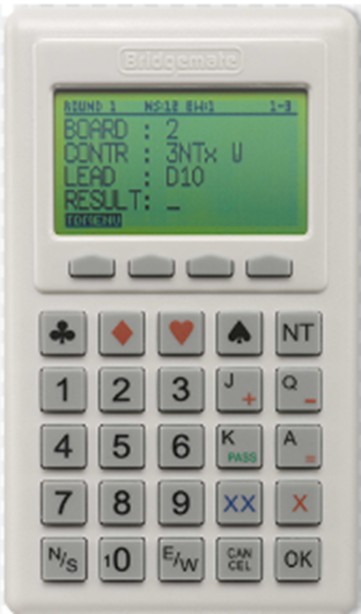
A year or two later, Pub Charity provided the funding for Bridgemates – calculators at each table where scores can be entered after a hand has been played. Results are produced as soon as a session has finished. New members take for granted what was unimaginable a couple of decades ago: immediate results.
X-Clubs
Life Member Michael Neels has worked with the club’s software developer Bob Fearn in Seattle to create X-Clubs, a program that combines the scores of several clubs on their standard club nights, establishing a list of supreme winners. This has become an innovative way of assessing players’ performance against a larger pool of tables.
The Cambridge Sixes Tournament
The Cambridge Sixes was also Michael Neels’ idea. It took the joint effort of the committee, club members and the generosity of other local clubs, to get this undertaking off the ground. Clubs are invited to enter a team of six players to compete. Originally held at the Senior Citizen’s Hall, then the Cambridge Town Hall and finally the Don Rowland’s Centre at Karapiro, this tournament has grown to become the largest one-day bridge tournament in the country. The Cambridge Bridge Club has hosted as many as 44 teams of six, or 264 players, all dressed in costumes, and many opting to stay in Cambridge over the weekend.
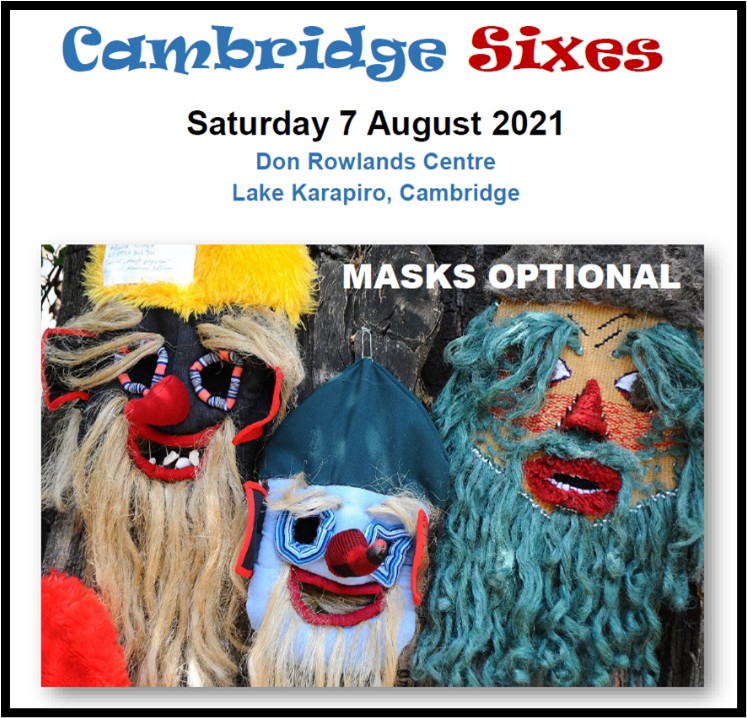
Cambridge Sixes Promotional poster soon after Covid-19
The Future
An important feature on the club’s calendar is their learner lessons in March. Past teachers have been Sue Wrigley, Marie Davis, Beat Moser, Clare Coles, Jane Stearns, Kim Grounds, Anne Blewden, Pam Moore and Josie van Weerd. A buddy system pairs each learner with an experienced player so that they integrate smoothly into regular club sessions.
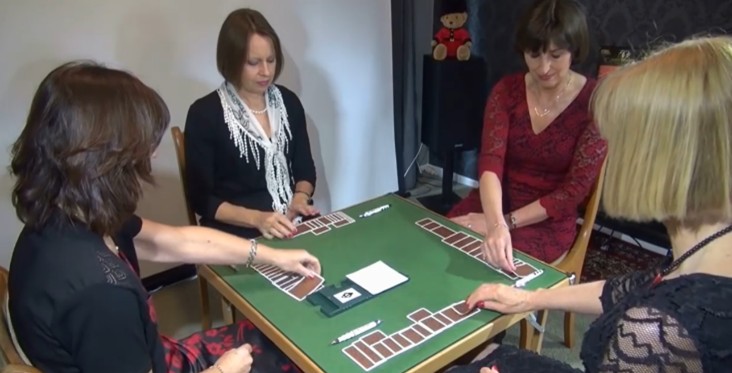
As of 2026, the Cambridge Bridge Club has over 200 members. Happy Golden Anniversary to the little club with a heart of gold.
Based on research by Alyson Clay, Bob McQueen and Karen Payne