
Monuments to his Foresight
-
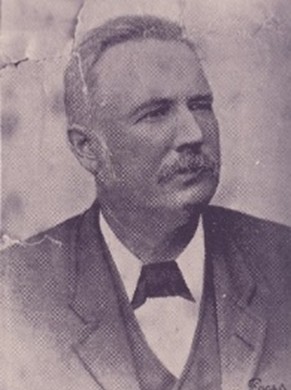
Frank (William Francis) Buckland – Cambridge Mayor 1898-1903 and 1905-1910
Cambridge was in an uproar when it was suggested that the saleyards move from Jubilee Gardens to a site on Taylor Street. The hotels would lose money and the town would die!
But Mayor Frank Buckland was determined to have the site for his proposed Town Hall, and so the move went ahead. The hall was the last stage of his ten-year modernisation plan, and the townspeople had agreed to a £5,000 loan to cover the cost.
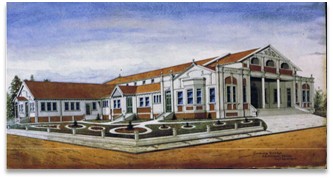
From 14 submissions they chose architect A B Herrold’s design, but the lowest tender was £194 above the agreed loan. The Council refused to pay more than £5,000, and Mayor Buckland resigned on the spot. But he returned two days later with the support he needed, and the building began.
The Cambridge Town Hall was only one of a long list of iconic buildings established during Buckland’s mayoralty.
The Buckland Family
Frank Buckland’s father William was from a rich family in Devonshire, whose members were quickly able to develop enterprises when emigrating to distant lands. William arrived in Auckland in 1841, learned the Māori language and began buying up Māori land in Auckland.
William bought lands in the Waikato that were granted to – and then abandoned by – militia soldiers who could not afford to develop them for farming. He also bought Māori land in the Waikato through the Native Land Court. Early settler William Moon implied in a memoir that Buckland had purchased around 90,000 acres of land.
Early life
Frank Buckland was born in Auckland in 1847. He was William and Susan’s second son. He became a civil engineer, and by the age of 21 he was managing the Una Battery Mine at Thames.
He had a poetic side. In his early twenties, he published a book of poetry “Morning Rays” containing lines such as:
Full oft I sing in changeful mood,
My dream of love, in solitude.
For Oh! I long to steal away,
And hide as ‘twere from light of day,
The thoughts that through my bosom roll,
While holding converse with my soul.
At age 23, he purchased a property from his future father-in-law and built a two-storeyed house in Remuera, now known as Araroa on St Vincent Avenue. He married Elizabeth Shipherd in 1869, and they had two children. As the family settled in Auckland, he became active in politics and was a member of various Boards.
In a discussion over a drink, the story goes that Frank made a bet that he could go back to university and become a lawyer in one year. He won the bet and was called to the Bar of the Auckland Supreme Court in 1884 aged 37.
Buckland was MP for Franklin North in 1884-1887 and for Manukau in 1890-1893. In the House, he became known as the “most satirical wag” who had ever sat in Parliament.
He was occasionally the butt of jokes. In October 1891, he was offered the “jawbone prize” immediately after he had finished his address at a meeting of Onehunga electors. Buckland took this in bad part, refused to accept the presentation, and said he would take an insult from no one.
In the Catholic Times in 1891, the “Wellington Watchman” wrote that “a most striking reason in favour of extending the parliamentary franchise to women – the first rotten egg which had been thrown at Mr Buckland during the recent election had been thrown by a girl.”
Buckland gave as good as he got:
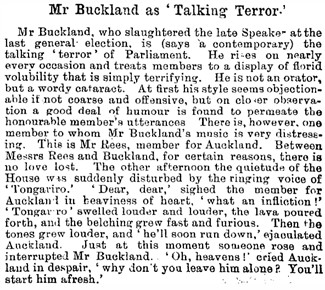
Observer, 22 August 1891
A move to Cambridge
Buckland had varied family land holdings in the Waikato, which is why the family moved to Cambridge in around 1894. He practised as a lawyer in town and became active in politics. He built legal chambers in 1898, a building that still stands in Duke Street.
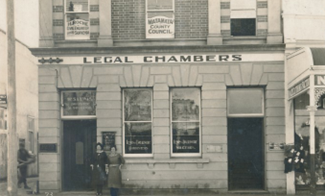
CM3164, Mr Buckland’s Legal Chambers taken in 1921, when occupied by Lewis & Dallimore
Within four years of his arrival, Buckland was elected Mayor of Cambridge. He was determined to push Cambridge into the 20th century – and so he did, but not without resistance.
The Saleyards: Buckland moved the livestock and farm equipment saleyards from the present Jubilee Gardens to a site in Taylor Street. This move aroused bitter controversy among farmers and business people alike. However, when the Council proposed building a Town Hall on the site (at a meeting in August 1900), many residents approved.
This didn’t stop Cr George Clark from suing Mayor Buckland for allegedly saying, during an altercation on the saleyards, “You are a lot of bloody scoundrels, damned dogs, I would not wipe my boots on you.” (Waikato Times 18/8/1906)
The Water Supply: In 1903 Buckland was instrumental in establishing the Town’s first water supply from Moon’s Creek, together with a water tower on Hamilton Road and water reticulations to parts of the borough. This led to the founding of the Fire Brigade, and to the building of a fountain in memory of Queen Victoria at the Duke and Victoria Streets “turnaround” on the intersection of the two streets.
Street paving: Buckland’s Council kerbed and channelled Duke and Victoria Streets and tar sealed two miles of business area streets.
In 1903, Frank Buckland retired from the mayoralty. He soon became dissatisfied with the slow actions of the new Mayor – particularly over the erection of a new high-level bridge over the Waikato. He stood again for election in 1905 and won by five votes.
Victoria Bridge: Buckland used his engineering knowledge to insist on the high-level bridge mounts having heavy rollers to withstand the harmonic vibrations set up by the hoofbeats of mobs of cattle and herds of sheep passing over it. He was on the committee that decided on the location and construction of the bridge. A ribbon was cut at the opening ceremony, with Elizabeth Buckland holding one end.
The Gas Works: He was ‘the mayor who set the town alight’ when he opened the gas works and lit up the Council Chamber for the first time in 1907.
The Post Office: The Prime Minister, Sir Joseph Ward officially opened the new Post Office, now the Alpino Restaurant, in 1908.
Sewerage System. In 1903, he developed the nucleus of a sewerage system for the business area. Halfway down the Duke Street hill, on the left, the original septic tank was in use until 1971, when a new ponding system was built. Altogether, Buckland had 6.5 miles of drainage and sewerage pipes installed.
The Technical and Manual Training School was opened in 1909 next to the Courthouse, which was opened the same year by the Minister of Justice, Hon. Dr Findlay.
The Cambridge Town Hall: Buckland himself laid the foundation stone in 1909. The Cambridge Museum holds the engraved silver trowel he used on the day.
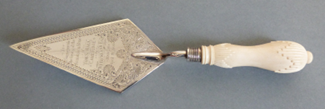
CM3752: Silver trowel used by Buckland in 1909
When a new Mayor and Council were elected in 1910, their agenda was to reduce the eye-watering amount of debt at the time – £30,000 for a community of 1,400 ratepayers. However, they acknowledged that Cambridge had become “a favourite residential centre.”
Prepared by Karen Payne for the Cambridge Historical Newsletter December 2025
References: The Bucklands of the Waikato J A C & M R Buckland; various articles searchable on Papers Past; Cambridge Town Hall photo book by Eris Parker, photographs and records from the collection of the Cambridge Museum.