
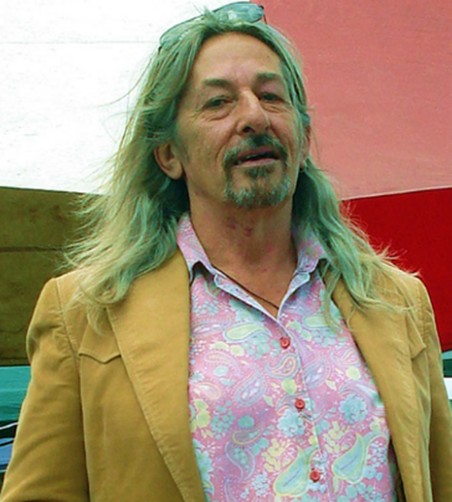
Ritchie Pickett – Fearless in Fashion
-
This article is based on Andrew Johnstone’s interviews with musician/music entrepreneur Grant Hislop and Ritchie’s sister Penny who volunteers for the Cambridge Museum. Please contact us if you wish to hear these interviews in full.
“Black polyester satin bibbed overalls, with purple pockets sewn in red thread.”
This is our formal description of an eye-catching, glossy textile recently donated to our collection by Graham Clark, author of the Ritchie Pickett biography Thanks for the Clap.
Ritchie Pickett was a long-haired, skinny 19 to 20-something when he wore these overalls in the mid-1970s. In photographs of him as a Graffiti Mk 2 bandmember, he’s shown as the epitome of 1970s glam, accessorising with black knee-length boots, furs, a bead necklace and makeup.
Ritchie lived his final years in Cambridge and died here in 2011, aged just 56. His connection to the town continued until recently through the Ritchie Pickett Scholarship supporting outstanding young musicians at Cambridge High School.
So who was Ritchie Pickett? He was a piano-pounding, sharp-tongued Kiwi country musician who moved easily from 70s prog rock bands like Think, to fronting Waikato band Ritchie Pickett and the Inlaws, to TV fame on That’s Country, with countless bands in between.
He was creative, intelligent, a prolific reader and poet. His sister Penny describes him as “a musician’s musician” who earned the respect of his contemporaries for his formidable talent and ability to entertain audiences with his ready humour and quick wit. In the few online videos that show Ritchie’s performances, musicians clearly enjoy playing with him. He was a naturally gifted pianist who could throw one-liners to the crowd without missing a beat.
A drinking problem meant that he never quite reached his potential. But if friends were let down by his behaviour, “many excused it because of the extraordinary way he related to people,” says Penny.
Grant Hislop was starting out as a music entrepreneur when he helped Ritchie professionally at a time when Ritchie’s genre (country/folk country and rock’n’roll) was no longer in vogue in the late-80s and early-90s. He employed Ritchie to write jingles for Hislop’s radio station The Rock in Hamilton, signed him to his record label, and was a member of Ritchie’s Hamilton band the Stingray Martini’s Excellent Duckbeasts. This was just one of the many Pickett bands carrying outlandish names.
Hislop remembers Ritchie with affection and describes him as “one in a million”, despite a rocky professional relationship. Ritchie was a prolific songwriter, and Hislop believes his songs will achieve fame in the future.
If two items of clothing were to best capture the essence of Ritchie’s outlandish personality, perhaps they were those donated to the Cambridge Museum by Graham Clark. We were excited to receive Ritchie’s iconic satin overalls – the only example we have of a textile worn by a genuine glam rocker of the 70s. Clark also donated a pair of Ritchie’s snakeskin shoes that show unconventionality in fashion continued throughout his life.
Written by Karen Payne for the February 2026 newsletter of the Cambridge Historical Society.
Historical Society Committee Member Andrew Johnstone is collecting interviews for our Voices of Cambridge oral histories project. His work on Ritchie Pickett captures not just the chaos, but the music and talent that made Ritchie a quintessential character in the history of NZ music.