Cambridge Collections
Cambridge Railway & Kissing Gates
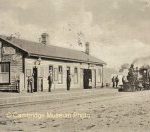
The Cambridge branch of the railway starts near Ruakura, and it was here that the first sod was ceremoniously turned on 6 May 1882.
Good progress was made on the section between Ruakura and Matangi. A kilometre south of the Newstead Station a five span timber bridge was needed to cross the Mangaonua Stream, and a contract to lay the permanent way over the full distance was let on 21 February 1884 at the price of £5,455.
On the morning of 1 October 1884 the line was inspected and passed ready for traffic. On 6 October a special train brought the new station master and his family along with other members of the staff to Cambridge and two days later the line was open for traffic.
The first public train was run from Cambridge to Hamilton leaving at 9.30 am. About 100 people made the one hour ten minute trip to Hamilton where a holiday was observed. The train then continued through to Huntly coming back in the early afternoon. At Hamilton a large crowd joined the train for a holiday afternoon at Cambridge and other people joined at various stations along the line.
The town was decorated with an arch at the railway crossing in Lake Street inscribed “Success to the Cambridge Railway”. The passengers were greeted with cheers from a number of people assembled at the entrance to the station and the local school children were waiting on the platform. They were then treated to a train ride to Matangi, where they ate and drank their fill of milk and buns before returning home.
Lines of bunting stretched across Duke Street, and the National Hotel was decorated with chinese lanterns which were lit that evening. Entertainment included boating on Te Koutu Lake, a cricket match, a fireworks display and a ball in the public hall that carried on into the early hours of the morning.
Regular services on the Cambridge branch were mixed (passenger and freight), stopping where or when required. The exception was the midday train which carried passengers only. Connections were made at Frankton Junction with services to and from Te Awamutu and Auckland, and it was possible to reach the latter in 6½ hours – a tremendous achievement in 1884.
During the 1920s, motor vehicles started to take over the passenger traffic and the last time-tabled passenger train left Cambridge without ceremony on 9 September 1946. The station building was sold and broken up in 1973 and an overhead crane was erected in its place to handle container traffic from Weddel Crown Aotearoa freezing works in Leamington.
A major user of the branch was the New Zealand Dairy Company factory at Hautapu and in 1999 the line stopped at the factory and the section to Cambridge was ripped up.
Kissing Gates
Another piece of Cambridge history is the Railway Gates. These gates served many passengers up to 1946 when railway passenger services ceased. They also prevented livestock escaping from the yards as cattle could not manoeuvre through the small gate.
The small curved gate was known as a ‘kissing gate’ because of the way the gate just ‘kissed’ the fence as it swung around. These gates were bought from NZ Rail by B & K James in 1981 and they donated them to the Cambridge Historical Society. They are still in place at the entrance to the Lakewood development.