
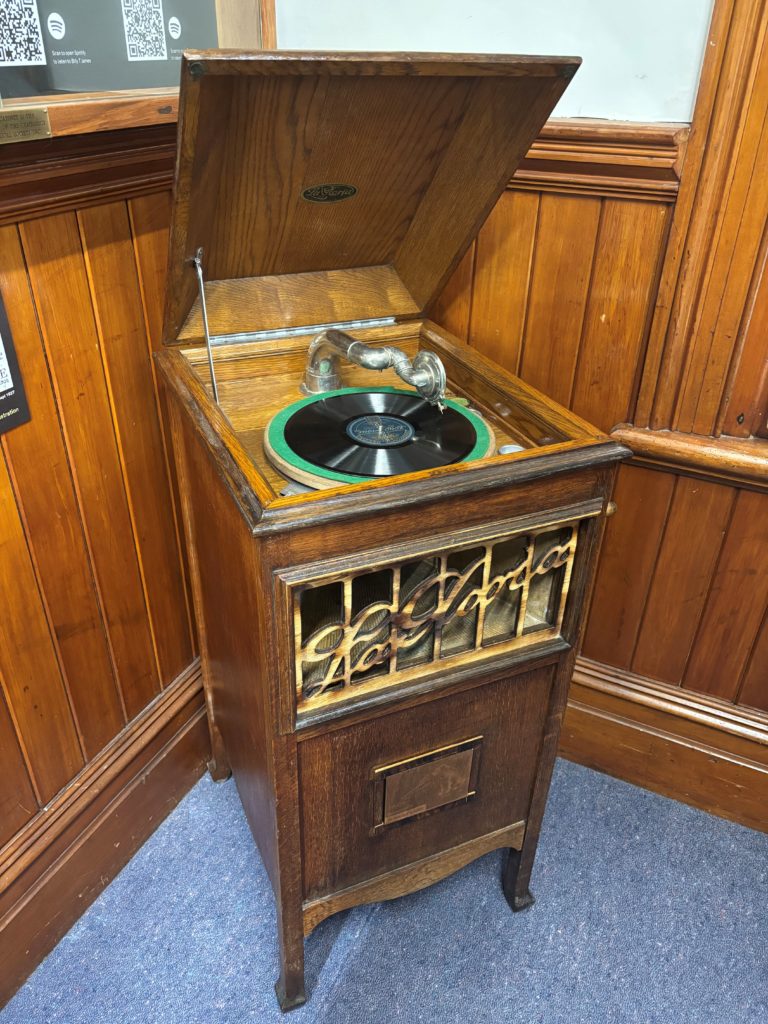
Listen to “Popular Jocular Doctor Brown” and other hits!
-
Despite so many innovations in sound recordings, records and record players have never really gone away. And this recent addition to our collection helps to explain why.
Cameron Knapp, the donor of this handsome La Gloria gramophone, is a keen collector and renovator of sound technology. He renovated this piece by replacing the La Gloria grille in the front, repairing the player and revarnishing the exterior. Cameron also donated a collection of records of the same era. These are made of shellac, which is heavier and more brittle than the vinyl records we know today.
Cameron told us that he has always been fascinated by the transmission of sound. His hobby is repairing players so that old records, reels and tapes can be played to a new generation of listeners.
La Gloria Gramophones Ltd
According to MOTAT, La Gloria gramophones were designed and manufactured by William Henry Newcombe of Auckland in the early 20th century. Between 1918 and 1922, Newcombe filed several patents on improvements to the diaphragm, sound-box, and amplifier components of these hornless ‘talking-machines’. Newcombe developed several different shapes of the amplification chamber and tone arm of the gramophone. He also made improvements to the diaphragm by a unique layering of strong paper, fine woven material such as silk, and a layer of cork. Newcombe claimed these improvements allowed for more accurate and attractive reproduction of sound, specifically of the human voice and music. Newcombe established Newcombes Limited (later La Gloria Gramophones Ltd) offering high quality New Zealand-designed and made gramophones to the New Zealand market.
W White of Victoria Street, Cambridge, advertised these gramophones in 1927.
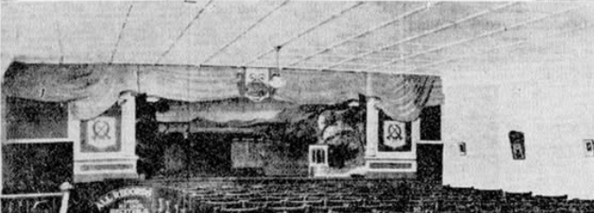
Papers Past: The Sun, 24 May 1930, p13
The above photograph shows the Recital Hall at La Gloria Gramophone Ltd at 155 (now 375) Karangahape Road. K Road Heritage’s Facebook page explains how Newcombe sold his gramophones, records and radiograms, and also had a recital hall on the first floor where people could listen to records and recitals. It may also have been used as a dance venue. The firm operated its own radio station which later became 1ZB Radio.
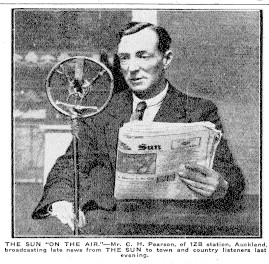 Papers Past: The Sun, 14/6/1927, p16
Thanks to Cameron’s donation, we can celebrate the work of Newcombe – a New Zealand innovator in the earliest days of sound recordings. This gramophone is just one part of our display on the history of music in Cambridge – Our Sounds Our Spaces – in 2026.
Written by Karen Payne for the June 2026 Cambridge Historical Society Newsletter.