If walls could talk
-
Walk down any Cambridge street and you will pass homes that have witnessed celebrations, tragedies, changing fashions and changing fortunes. Most reveal very little from the footpath. Behind an ordinary front door might be a Swedish name with an unexpected origin, a magnificent Venetian chandelier shipped halfway around the world, or a pair of stone lions that have welcomed visitors for almost a century.
The challenge, and the fun, is discovering how those stories fit together.
Over the past two years, volunteers at the Cambridge Museum have been researching the histories of many of the town’s homes, businesses and public buildings as part of our Built Heritage Stories project. Building on earlier work by Dinah Holman, Eris Parker and Jennie Gainsford, today’s volunteers have been piecing together the stories that transformed houses into homes and streets into communities.
The work has taken us through newspapers, survey plans, electoral rolls, photographs, family papers and countless other records. Sometimes the answers appear quickly. More often, one discovery simply raises another question.
One of the richest stories we have encountered came not from the Museum itself, but from family historian Beverley Bell.
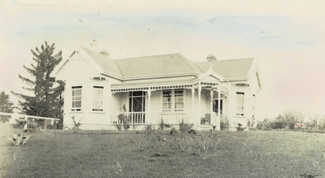
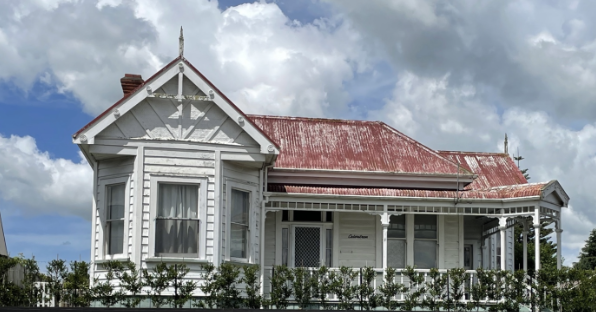
1 Cook Street, dated 1914, just after the house was built
Following in the footsteps of her father Frank Bell, Beverley has spent years researching her family’s history. When she completed her history of the Bell family home, Cederström, she generously shared it with the Museum so it could become part of the Built Heritage Stories collection.
Her research answered questions that had puzzled generations. Why does a Cambridge villa carry such a distinctive Swedish name? How did the property evolve from land surveyed after the Waikato War into one of Cambridge’s significant homes? How did road improvements permanently change the property by claiming part of Matilda Bell’s beloved croquet lawn?
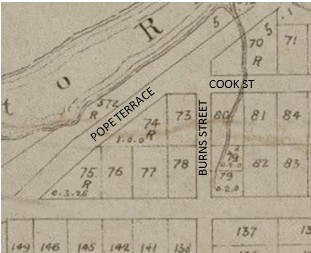
Excerpt from 1878 Survey Plan of Cambridge West, showing Lot 73 https://kura.aucklandlibraries.govt.nz/digital/collection/maps/id/291
NB: The street names have been added by us.
Along the way she uncovered delightful details. A spectacular Murano glass chandelier carefully brought home from Europe in 1939. A beautifully crafted model of St Andrew’s Church displayed in the entrance hall. The familiar stone lions that still stand guard at the front gate.
It is these unexpected discoveries that make local history so rewarding. Every answer seems to lead somewhere new.
But even the most thorough documentary research has its limits. Official records tell us who owned a house. Memories tell us what it was like to live there.
To add another layer to the story, Beverley introduced us to her relatives Judy and Jonathan Green, whose childhood memories brought Cederström vividly back to life.
They remembered gleaming timber floors, ornate pressed-metal ceilings, toast cooked over the coal range, rainwater carefully collected for washing hair, and her grandmother Matilda sitting by the front window watching life unfold beyond the Waikato River.
Those memories are every bit as important as the dates and names recorded in official documents. They remind us that heritage is not simply about architecture; it is about the lives of the people inside.
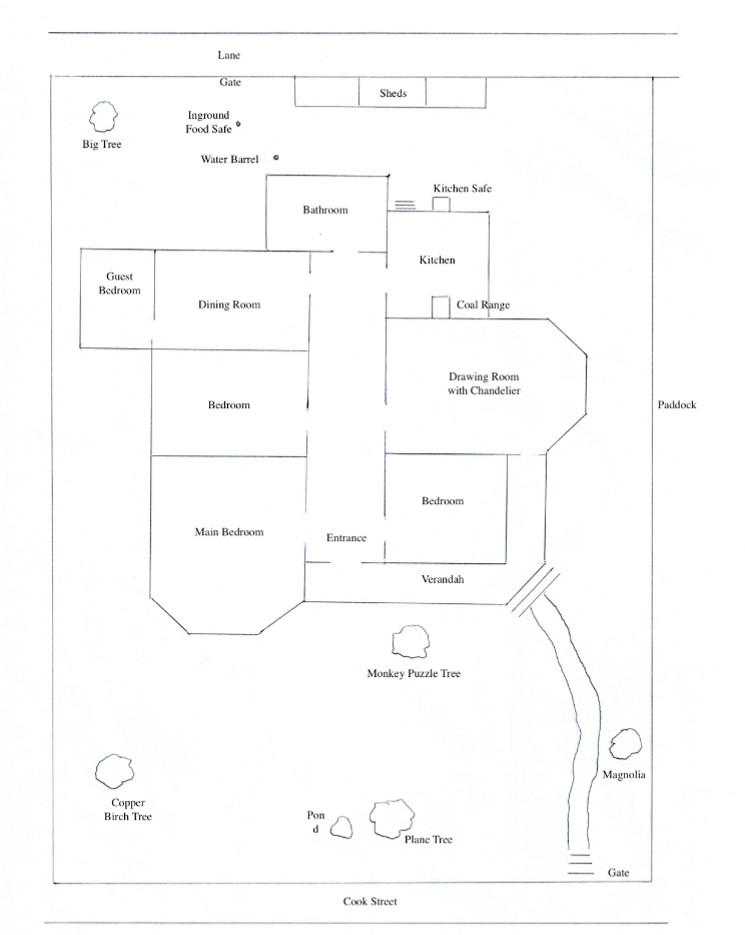
Floor Plan of 1 Cook Street, as remembered by Jonathan Green. Hand-drawn and not to scale. Supplied by Beverley Bell.
That is perhaps what has surprised us most during the Built Heritage Stories project. One family researches names and dates. Another remembers the stories that explain them. Volunteers uncover newspaper reports that nobody has read for generations. Old photographs identify a long-forgotten verandah or garden. Piece by piece, the picture becomes clearer. It is history built through collaboration, curiosity and generous sharing.
Over the coming months, more Built Heritage stories will be added to the Cambridge Museum website, allowing readers to explore the histories hiding behind familiar façades. You may discover that a house you have driven past for years has a story you never expected.
Better still, you may realise that your own family holds the missing piece of someone else’s puzzle.
Written by Elizabeth Harvey, with thanks to Beverley Bell, for the Cambridge Historical Society newsletter for August 2026.