
Cambridge Collections
From Lumber Room to Police Hub: The Changing Face of Cambridge’s Police Station
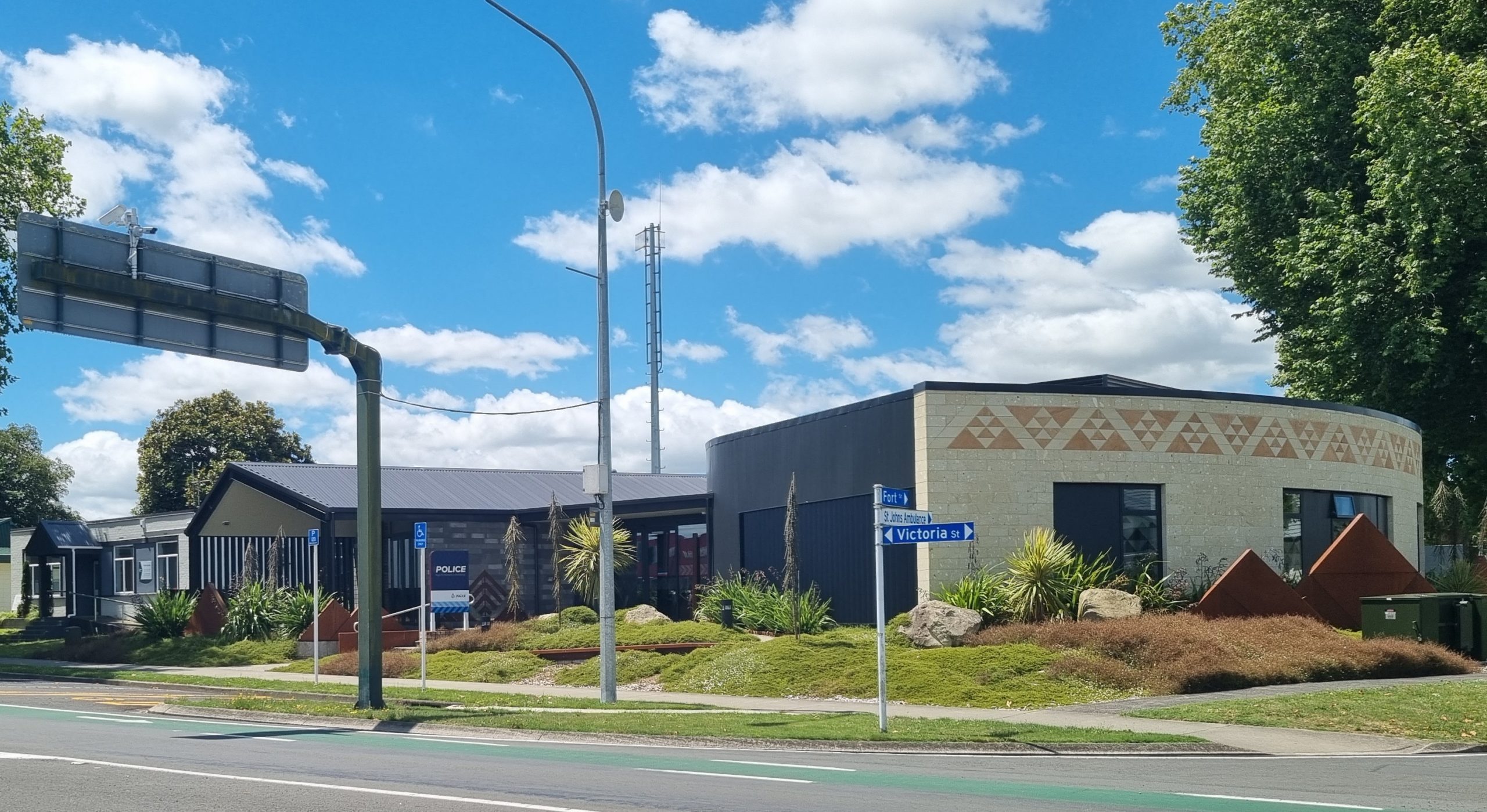
Cambridge Police Station, photographed on 8 January 2026.
The Cambridge Police Hub, completed in 2022 on the corner of Fort and Victoria Streets, marks the latest chapter in an evolving story of policing in the town. Designed by PAUA Architects, the building reflects a partnership between New Zealand Police and Tainui Group Holdings and signals a deliberate shift away from the traditional police station model.
The hub is designed to feel open, welcoming and grounded in place. Its form draws inspiration from a double-hulled waka, symbolising partnership and collective purpose. Design elements reference the Waikato awa (river) and surrounding maunga (mountains) that are significant to local Māori. Materials from the previous police station were reused, linking past and present, while murals, carved steel pou and patterned stonework embed local stories into the building itself. The inclusion of a whānau (family) room and flexible workspaces reflects a contemporary understanding of policing as community-facing and relationship-based.
Officially opened in September 2022, the hub was blessed by iwi and marked by speeches from police and community leaders. It has since been recognised with architectural awards, acknowledging its cultural narrative and response to place.
Early Policing in a New Town
To understand how far Cambridge policing has changed, it helps to step back to the town’s beginnings.
In the 1860s, following the Waikato War of 1863–64, the first colonial authority in Cambridge was the 3rd Regiment of the Waikato Militia. Stationed at the Star Redoubt on Fort Street, the militia provided basic security, communications and enforcement in what was then a military town. When the militia was disbanded in 1867, its duties passed to the Armed Constabulary, whose members combined policing with road building, guarding and other Government work.
A unified national police force was established in 1886, but Cambridge lacked a purpose-built station.
“None Too Soon”
Newspapers of the day show growing public frustration. On 13 April 1882, the Waikato Times reported that “At present the office of the local constable is nothing more than a spare corner of a lumber room, in which is kept a goodly portion of reserve stores, the situation, moreover, being anything but convenient. Persons in search of information find their way to the private residence of Constable Brennan, which certainly does not tend to his domestic comfort.” (Source: Papers Past) . Read more about Constable Brennan’s experiences here.
Finally, in 1899, a police house was constructed. Built of kauri at a cost of £335 13s 2d, it served as both residence and workplace, with the police office opening directly off the front verandah. Policing was literally part of domestic life, visible and accessible to the community.

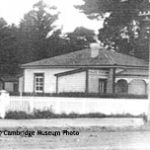
Cambridge Police Station on right, probably in the 1910s. It is next to the Cambridge Court House (now Museum) and the Cambridge Manual Training and Technical School on Victoria Street CM2958.23.6712
Temporary Fixes and Long Delays
Over the following decades, the inadequacy of police accommodation resurfaced repeatedly. At times, the station operated from the courthouse, the drill hall or temporary lean-to structures. In 1939, the Commissioner of Police discussed plans for a new residence beside the courthouse, but the outbreak of the Second World War delayed building again.
By 1945, the situation had worsened. The station accommodation was described as a “glorified corrugated iron lean-to,” accessible only by “tramp(ing) through a paddock.” The Chamber of Commerce wrote repeatedly to the Commissioner, objecting to facilities that were neither suitable for officers nor convenient for the public. Shortages of materials after the war meant that even when a police house stood empty, it could not be renovated for use.
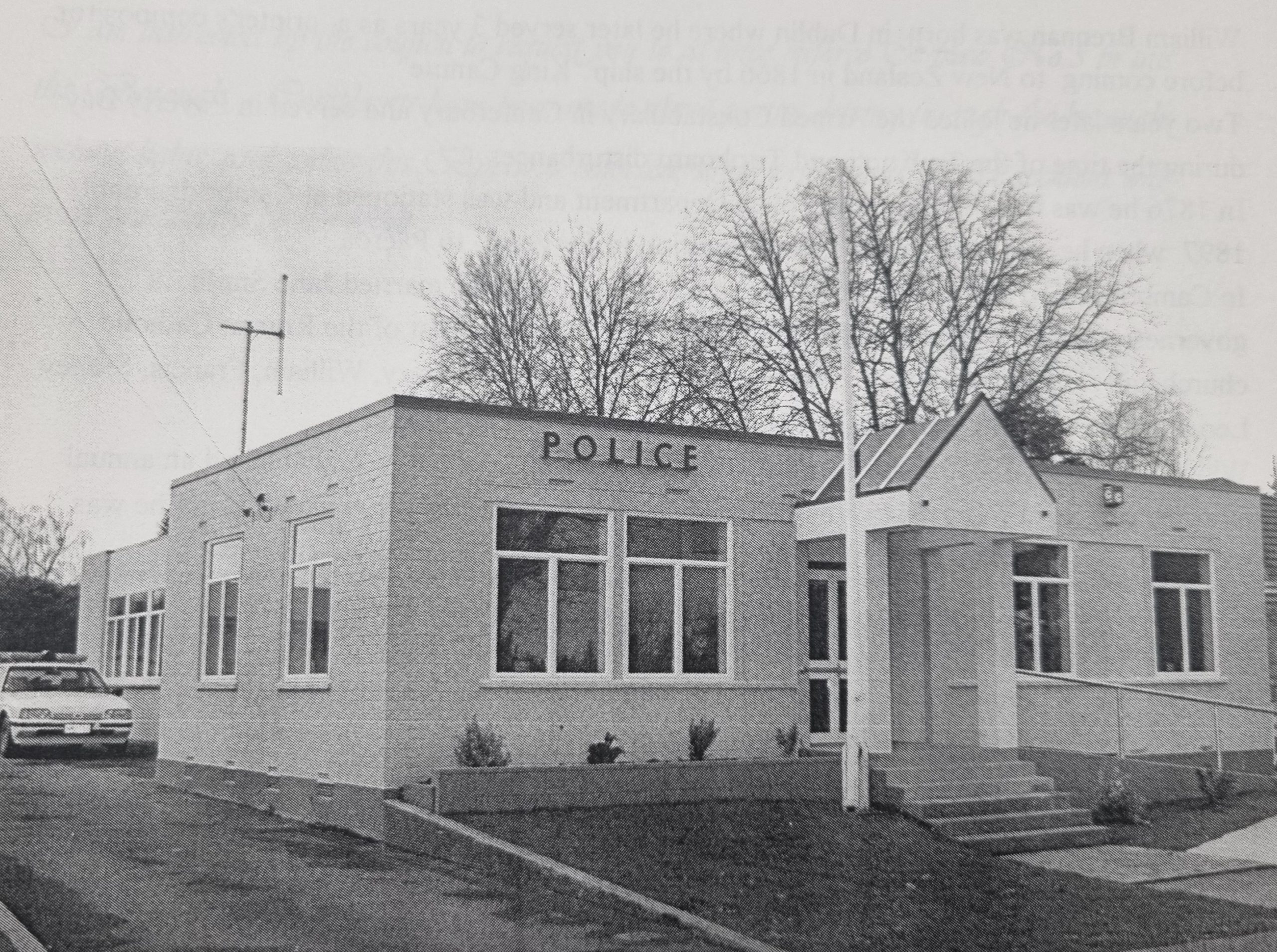
Cambridge Police Station, Victoria Street, 1954-1997 (Source: Eris Parker 1996)
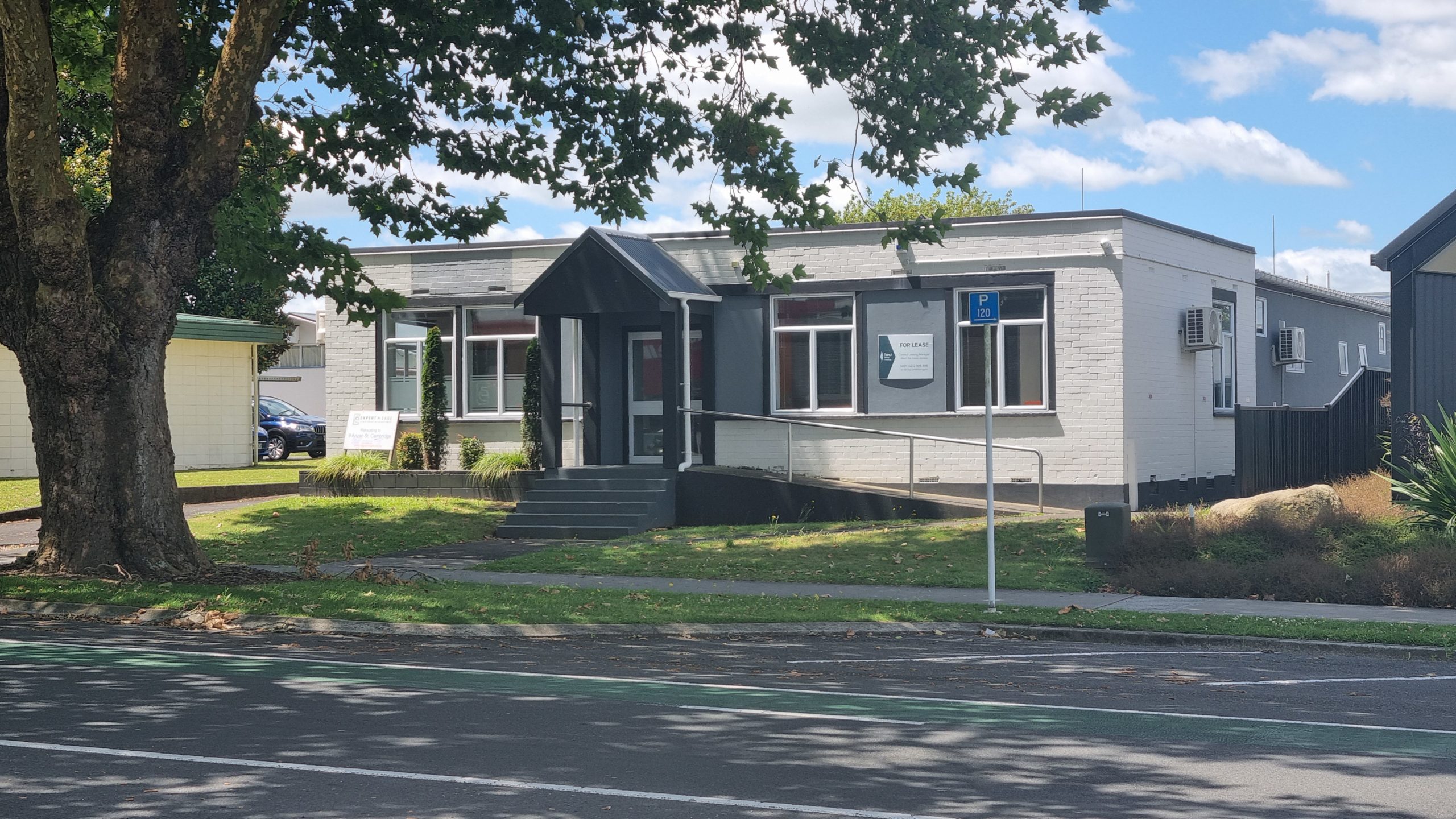
Former police station in Cambridge, now offices, 8 January 2026
A Permanent Station at Last
Construction of a new police station finally began in 1953, on Victoria Street between two police residences. In May 1953, the Waikato Independent reported “The contractors SPND Ltd have been on the job in connection with the building of a new police station in Cambridge on a site between the two police residences in Victoria Street.” (Source: Waikato Independent, May 1953 quoted in Parker 1996 p12)
By January 1954, the brick station was nearing completion. Contemporary reports praised it as practical and dignified, with a clear public entrance, office space, and modern conveniences. It would serve Cambridge for decades.
“The new station should be most convenient, comprising as it does, four rooms and conveniences. The new building looks serviceable and is in keeping with the newer brick residence. The approach to the portico is up six concrete steps and on entering one finds what will be the public office on the right. Then there are two good sized rooms for the staff and a smaller room for records etc.” (Source: Waikato Independent, Jan 1954 quoted in Parker 1996 p13)
The original police house was moved to Tauwhare in September 1966 to serve as a private residence.
In 1990, extensions to the police station were completed with care taken to preserve its architectural character. The station was officially reopened in June that year, with an open day inviting the public to explore the building, view historical displays and meet local officers.
In 1992, Cambridge Police merged with the Traffic Safety Branch and bigger premises were needed. The police station later moved to Dick Street in 1997 and remained there until the opening of the new building in 2022.
People Behind the Badge
Buildings tell only part of the story. The first constable in charge of Cambridge was William Brennan. His uniform consisted of a blue cloth cap with peak and band of black braid, loose blue cloth jumper with uniform buttons, blue cloth trousers, strong lace-up watertight boots, a great coat, a waterproof coat and white gloves. (Source: Police from 1886-1930)
Officers such as Constable Charles Henry “Harry” Maisey, who served in Cambridge from 1935 to 1944, were well-known and widely respected figures. One of the last mounted policemen in New Zealand, Maisey kept his horse in the paddock behind the station, on land now occupied by the modern police hub. His role extended well beyond law enforcement, offering support and stability during difficult economic years.
A Continuing Story
The history of the Cambridge Police Station mirrors wider changes in New Zealand policing. It traces a path from military control to civil authority, from makeshift offices to permanent buildings, and now to a police presence shaped by partnership, culture and community connection.
The 2022 Police Hub does more than replace an old building. It stands as a visible marker of how ideas of public service, place and people have evolved in Cambridge over more than 160 years.
Sources:
Eris Parker (1996) The Cambridge Lot: A Police History (3718) Available in the Cambridge Museum library
Paua Architects https://www.pauaarchitects.co.nz/projects–cambridge-police-base/
Tainui Group Holdings https://www.tgh.co.nz/what-we-do/real-estate-assets/police-stations/
Cambridge Police Base opens, 21 September 2022, Cambridge News https://www.cambridgenews.nz/2022/09/cambridge-police-base-opens/
Digital copies of the Cambridge News from 2020 onwards are also available in the Museum Archive.
Local newspaper coverage:
Digital copies are available up to 1949 on Papers Past. Later copies are in the Museum collection.
https://paperspast.natlib.govt.nz/newspapers/WT18820413.2.11
Progress in Cambridge, Waikato Independent, 12 August 1946, p4 https://paperspast.natlib.govt.nz/newspapers/WAIKIN19460812.2.14