
Cambridge Collections
The Armed Constabulary in Cambridge 1867-1886
From Militia to Armed Constabulary
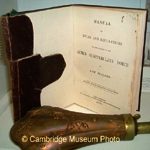
The Armed Constabulary Act of 1867 marked a turning point in New Zealand’s approach to law and order. With its passage, the Waikato Militia was disbanded and responsibility for policing and defence shifted to the Armed Constabulary, a force that combined military and civil duties.
Armed Constabulary Officers were distinctly uniformed, reflecting their hybrid role. Foot constables wore blue cloth caps without a peak and a with silver lace band 1¾” (45 mm) wide, a blue cloth or serge jumper with twisted silver cord shoulder knots and blue cloth or serge trousers with a ¼” (6 mm) red band down the outside seams.
Mounted Officers wore Bedford cord breeches and Napoleon boots with hunting spurs. Trousers for Mounted Officers were blue cloth with a double white stripe ¾” (19 mm) wide down the seam. They were also equipped with a sword in a steel scabbard hung on a brown leather sword and pouch belt, a revolver and white buckskin gloves.
Other ranks wore a jumper cut to cover the waist only, black cloth or blue serge trousers with red piping on the seams, Blucher boots, blue cloth cap with white piping in seams and a white ball on top. White cotton braid chevrons worn on the right arm showed distinction of rank.
Mounted men wore plain blue serge jumpers made full to fall over and tie around the waist, with low cut collar, and shoulder cords of white cotton twist.
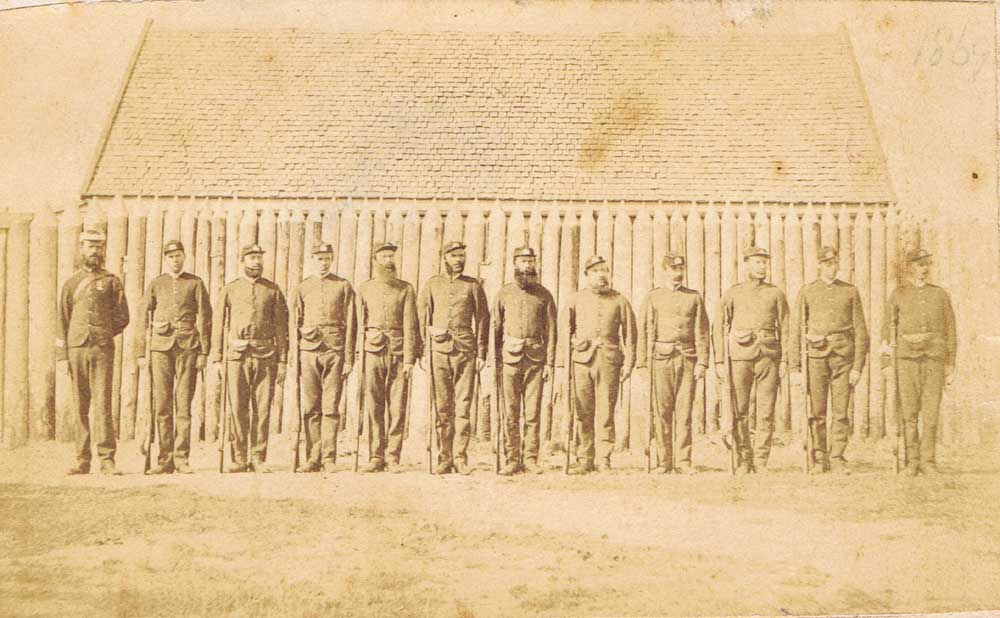
Armed Constabulary, Cambridge CM2958/1/44
Establishing the Force in Cambridge
Lieutenant-Colonel William Moule raised two divisions of Armed Constabulary and commanded one himself (No. 4 division) with his Headquarters in Cambridge. The other (No. 5 division) was commanded by Major von Tempsky at Alexandra (Pirongia).
Each division consisted of one inspector, two sub inspectors, three sergeants, three corporals and sixty constables. As married men were not eligible to enlist in the Armed Constabulary (and it was mainly married militiamen who had held onto their farms in the Waikato), most of these single men were recruited in Auckland. The Armed Constabulary now shared jurisdiction with the Auckland Provincial Police.
Conflict, Control, and Communication
Tensions remained high in the late 1860s and early 1870s. The presence of Te Kooti led to an increase in the force, which reached 200 men by 1869–70. In April 1870 Lieutenant-Colonel Lyon took command of the New Zealand Armed Constabulary which took over from the Auckland Provincial Police. One of their first tasks was practical rather than martial: repairing telegraph lines linking Cambridge with Te Awamutu and Hamilton, vital for communication and control.
Arms, Training, and Readiness
Arms and training were taken seriously. In 1871 the force was re-equipped with Snider rifles, replacing unreliable carbines. As historian C. W. Vennell later observed in his book ‘Such Things Were’, these weapons mattered deeply to men who lived and worked alongside their arms, never certain when violence might erupt. A rifle range was built at Carters Flat, later extended to nearly 900 yards, to maintain proficiency and break the monotony of garrison life.
Fear, Redoubts, and Daily Reality
The murder of Timothy Sullivan on 24 April 1873 brought renewed tension, and again during the Te Kooti scare families were brought into the barracks at night. New redoubts were built at Pukekura, Paekuku, Roto-o-Rangi, and the ford across the Punui River, but these were withdrawn in 1875 and 1876.
The activities wound down and the Armed Constabulary’s general duties were keeping communications open and making roads, the town constable keeping the peace, law and order, digging gardens, wheeling gravel, fencing paddocks, planting trees, and guard duties. Approximately 22 men were stationed in Cambridge and from the ‘office’ in the corner of the lumber-room, the town constable and watch house duties were administered.
Building the Town and Community Life
From 1877-1886 the New Zealand Constabulary Force had jurisdiction. The new Bill enabled the constabulary “to act as constables in and throughout the colony, for putting down rebellion, quelling disturbances, preserving the peace, preventing robberies and other felonies and apprehending offenders against the peace.”
The Waikato Times of 4 September 1880 reported, “The constabulary are doing good work on the streets in Cambridge. Fort Street has been very much improved within the passed [sic] few weeks. It has been leveled and a number of the force is at present busily engaged in laying on gravel. Alpha Street west is also undergoing a change. This street has for years sadly been in want of improvement and the present alterations in the level of Victoria Street renders it necessary that something should be done at once.
“Although many of the back streets are sadly in want of attention it must be satisfactory to know that the work of improvement is steadily going forward. The engineer Mr Hoskins is just now taking levels of that part of Victoria Street between the English church and the Government paddock with a view to forming a permanent roadway as well as for the purpose of perfecting the drainage arrangements.
“The circumstance of the newly planted trees being on the present road induces this step more directly, but the work has long been regarded as one of the greatest importances.
“At one time it was almost decided to carry the surface water lying on the roads in the upper portion of the township into a huge well which was to have had subterraneous communication with the lagoon, but the scheme now almost to be adopted into our mind much to be preferred.
“It is also intended to form Lake Street from Mr Carter’s stable to Whitaker Terrace, thus affording additional means of access to the Domain. When the Domain Board shall have planted this portion of their trust it will be a very desirable neighbourhood.”
The Armed Constabulary also became part of the town’s social life. In 1882 the Armed Constabulary trounced the locals at cricket, the A C doubling the score. Next year the locals made a better showing, losing by only 17 runs. A sports day was organized for the Armed Constabulary before they went out to their summer road works and the Armed Constabulary reciprocated with a Ball. The Public Hall was decorated in a manner altogether unprecedented, no pains having been spared to secure perfection in this as well as every other respect. Dancing was kept up with spirit until daylight.
During 1883 the Armed Constabulary force worked on the Cambridge cemetery, the Karāpiro bridge, the town square and Thornton, Rotorua and Oxford Roads. They tended to the upkeep of the Roman Catholic grounds, were commended on their well-kept quarters and made considerable improvements to the rifle range.
At the same time, conditions could be harsh. Reports described poor accommodation, inadequate tents for road parties, and overcrowded barracks. Illness was common, and criticism of official priorities appeared even in carefully worded letters to the press. It was against the rules for members of the Armed Constabulary to write to public journals.
Conditions for the Rotorua Road party were described in the New Zealand Herald as “not fit for dogs”. The tents were rotten and there were difficulties getting food to the men.
The need for a hospital for the men was indicated in a letter to the editor of the Times from ‘Sans Peur’. He stated that, “40 men – well and infirm – slept in one barrack while the carpenters were kept busy making furniture for the officers.” The editorial in the next issue suggested that “the government wouldn’t have to make retrenchments as the force was thinning out through disease.”
Transition to Civilian Policing
By mid 1884 a full troop of NZ Armed Constabulary Force was no longer required in Cambridge. All movable buildings and most of the personnel were transferred to Kihikihi, leaving Constable William Brennan to continue local policing duties. Over the following two years the Armed Constabulary was gradually absorbed into regular policing or military roles, or disbanded altogether.
On 1 September 1886, following the passage of the Police Force Act and the Defence Act on 18 May 1886, the New Zealand Police Force officially came into being. This marked the end of the Armed Constabulary era and the beginning of a civilian police service, closing a formative chapter in Cambridge’s early history of law, order, and settlement.